
🧭 What the Immune System Does Overview
- Core job: tell "self" from "non-self" and respond to the non-self in an organized way.
- Second job, separate from fighting outside invaders: clear out the body's own cells once they become sick, injured, stressed, or dying.
- Two cooperating branches accomplish this:
- An immediate, broad-acting branch.
- A slower, precision-targeted branch that improves with repeat exposure.
⚡ Innate Immunity First Responder
- Acts as the body's opening defense the instant a threat appears — no learning period needed.
- Built from several layers of defense working together:
- Structural barriers — intact skin, mucosal linings, and the resident bacteria that crowd out invaders.
- Environmental/chemical barriers — body temperature, local pH, natural antimicrobial molecules, and signaling proteins (cytokines).
- A cascade of blood proteins (the complement system) that can punch holes in microbes and flag them for destruction.
- Cellular defenders — phagocytic cells and granule-containing white cells that engulf or poison invaders on contact.
- The inflammatory response, which recruits more defenders to the site of damage.
Defining Features
- Ready to fire from birth — does not require a prior encounter with the threat.
- Recognizes only broad, shared molecular patterns common to many microbes (PAMPs) or released by damaged host cells (DAMPs) — not one exact antigen.
- Works with a small, fixed set of recognition receptors — so its target range, while broad-acting, is not infinitely varied.
- Responds with the same intensity every time — repeat exposure does not make it faster or stronger.
Exam trap"No memory" is the single feature that separates innate from adaptive immunity — test writers love this contrast.
🎯 Adaptive Immunity Precision Defense
- Built around two lymphocyte populations — B cells and T cells — plus the specialized effector cells they generate.
Defining Features
- Each individual lymphocyte is programmed to recognize one, and only one, specific antigen shape.
- Across the whole lymphocyte population, an enormous variety of different antigen receptors exists.
- Improves with every repeat encounter — this is immunologic memory.
- Actively distinguishes the body's own tissue from foreign material.
- Winds back down once the threat is cleared rather than running indefinitely.
Why Each Feature Exists
- Specificity + memory together → durable protection against a pathogen that returns or persists.
- Population-wide diversity → coverage against essentially any pathogen the body might meet.
- Division of labor among effector cell types → the right tool for each kind of threat.
- Self/non-self discrimination → prevents the immune system from attacking the body's own tissue (autoimmunity).
- Self-limitation → returns the system to baseline to save resources and prevents runaway lymphocyte proliferation, which is the seed of leukemia or lymphoma if left unchecked.
📊 Innate vs Adaptive at a Glance Comparison
| Feature | Innate | Adaptive |
|---|---|---|
| What it recognizes | Shared microbial/damage patterns (PAMPs/DAMPs) | One precise antigen per lymphocyte, microbial or not |
| Diversity of targets | Limited | Extremely high |
| Memory on re-exposure | None | Yes — faster, stronger response |
| Attacks self tissue? | No | No (when working correctly) |
| Structural/chemical barriers | Skin, mucosa, normal flora, temperature, pH, antimicrobial peptides | Lymph nodes, spleen, mucosa-associated lymphoid tissue |
| Key blood protein system | Complement | Antibodies |
| Signature cells | Phagocytes, granulocytes, NK cells | B lymphocytes, T lymphocytes |
🔄 How the Two Arms Cooperate Function
- Innate defenses fire the moment a pathogen breaches the structural/chemical barriers — often enough on its own to shut the infection down.
- If innate defenses cannot keep up with pathogen replication, they hand the job off to the adaptive branch — activating it in a pathogen-specific way.
- Building an effective adaptive response is not instant — expect roughly one to two weeks from first infection to true antigen-specific clearance by antibodies and effector cells.
- Once the pathogen is gone, both branches stand down — but not completely:
- Leftover antibodies and surviving effector cells give ongoing short-term protection.
- Memory lymphocytes remain behind, giving long-lasting protection against that same threat.
Timeline of a Typical Infection
① Innate response fires immediately
② Adaptive response is switched on
③ Adaptive response peaks and clears pathogen
④ Memory cells persist long-term
The Cross-Talk, Step by Step
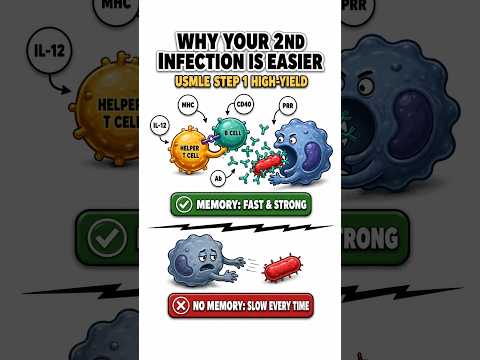
- Phagocytes detect PAMPs through pattern-recognition receptors and engulf the pathogen.
- Those same phagocytes display fragments of the pathogen to T lymphocytes and release signaling cytokines — this kicks off an antigen-specific response.
- Activated T lymphocytes release their own cytokines, which boost the killing power of phagocytes even further.
- Cytokines from both phagocytes and T lymphocytes push B lymphocytes to mature into antibody-secreting plasma cells and to switch which antibody class they produce.
- The resulting antibodies finish the job three ways: coating the pathogen to make it easier to eat (opsonization), triggering the complement cascade, and marking infected cells for destruction by other immune cells.
Barriers breached→
Phagocytes + complement→
Cytokines→
T lymphocytes→
B lymphocytes→
Antibodies feed back to phagocytes/complement
High yieldThe two arms run on a positive-feedback loop, not a one-way handoff — cytokines and antibodies keep cycling signals back to the innate side throughout the response.
💡 Clinical Pearls Pearls
- If a question describes a faster, stronger response on second exposure to the same organism, the answer is adaptive immunity / immunologic memory — not innate immunity, no matter how fast innate defenses normally act.
- Innate immunity's "limited diversity" refers to a small number of pattern-recognition receptor types, not a small number of cells.
- Self-limitation of the adaptive response isn't optional housekeeping — failure of this brake is one route to lymphoid malignancy.
- Complement belongs to the innate arm; antibodies belong to the adaptive arm — even though both are soluble blood proteins that destroy pathogens.